Blog
Get Your Degree in Japanese Knife Types

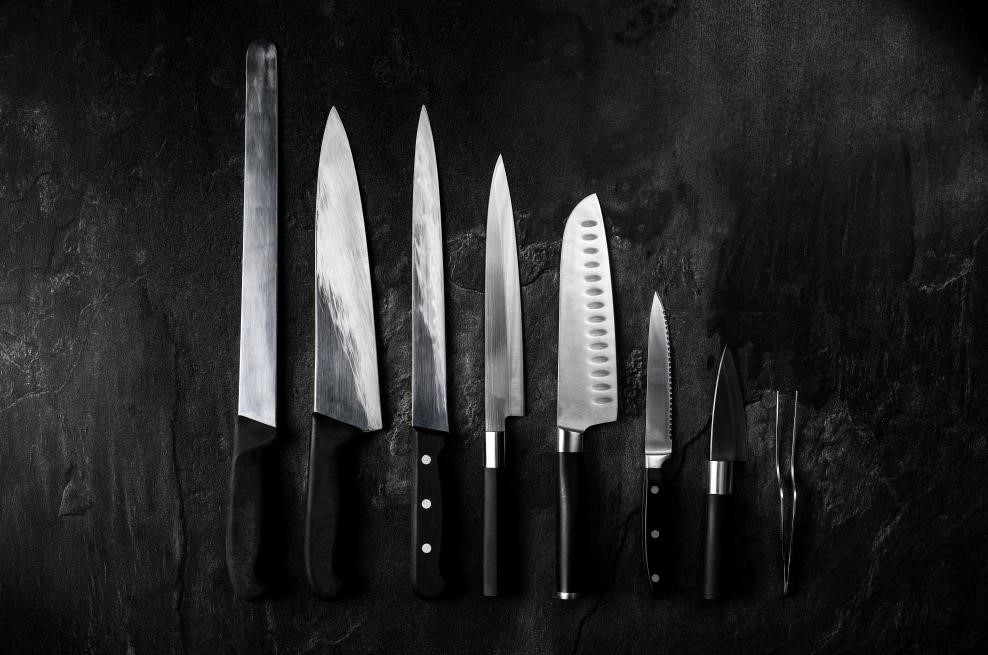
KITCHEN KNIVES
Get Your Degree in Japanese Knife Types
2022-07-21
Most artists can tell you that a critical aspect of their craft is choosing the right art supplies. Cooking is no different. Chefs know that using the right tool at the right time can make or break a masterful dish.
When it comes to the culinary arts, it’s no surprise that Japanese tools are widely regarded as the golden standard. With over 200 Japanese knife types to choose from, it’s sometimes difficult to bring the perfect blade to an undecided customer.
That’s why we’ve put together this list. For anyone in the knife business, distinguishing between these popular Japanese-style tools is a priceless skill.
The best part about our Japanese Knife Academy? There’s no tuition. Sounds good? Then let’s get you started.
Japanese Knives: Introductory Course
A samurai and a chef walk into a bar. This might be the beginning of a joke, but it’s actually the birth of the flourishing Japanese knife industry we know today.
The oldest Japanese knife dates from the Nara period (710–794) and looks like a miniature version of a samurai sword. For the following 200 years, knives were used mainly by aristocratic classes and were regarded as sacred.
The belief that the chef’s soul would inhabit the knife took root around this period and made way for modern Japanese chefs to pay considerable respect to their tools.
Even today, old knives that break or become too dull to be sharpened aren’t thrown away but buried at special mounds called Hocho-zuka.
During the 16th century, tobacco farmers demanded blacksmiths to produce knives sharp enough to harvest tobacco leaves, laying the foundation for today’s exceptional Japanese knife quality.
During the Edo period, food purity laws encouraged the creation of specialized blades influenced by regional cuisine. Most households owned a Deba and Nakiri.
With the Meiji period, Japan opened to the West, introducing beef and Western blacksmithing methods—leading to multi-purpose knives like the Gyuto-bocho.
Today, Japan boasts over 200 knife types, blending tradition with Western adaptations for global use.
Multi-Purpose Japanese Knives 101
Gyuto

8Cr13MoV Clad Steel · Octagonal Rosewood Wa Handle · 200 mm
The Gyuto is often considered the crown jewel of Japanese craftsmanship. As the Japanese equivalent of a chef’s knife, it excels at rock chopping, pull-cutting, and push-cutting meats, vegetables, and fruits.
Gyuto vs. Chef’s Knife
The Gyuto favors push and pull cuts and uses traditional Japanese steel, while Western knives excel at rock chopping for vegetables.
Santoku

8Cr13MoV Clad Steel · Octagonal Rosewood Wa Handle · 175 mm
“Santoku” means three virtues—slicing, dicing, and chopping. Lightweight and precise, it shines in fine culinary work.
Santoku vs. Gyuto
Santoku knives are smaller and more delicate, ideal for refined dishes and smaller hands. Gyutos handle tougher foods better.
Santoku vs. Chef’s Knife
Santokus are lighter and sharper but less forgiving than Western chef’s knives for rapid task-switching.
Kiritsuke
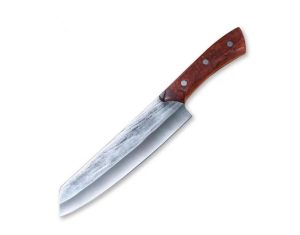
8Cr13MoV Rosewood Kiritsuke Gyuto · 200 mm
A hybrid of Gyuto and Yanagiba, the Kiritsuke is a status symbol among executive chefs. Its reverse-tanto tip makes it ideal for sushi and intricate work.
Bunka
A Santoku with attitude. Featuring a reverse tanto point, it excels with seafood and precision cutting.
Chukabocho
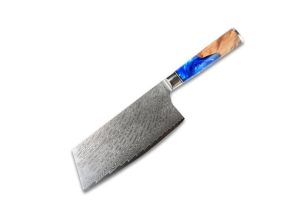
Damascus Clad 9Cr18Mov · Oval Stabilized Wood · 190 mm
Known as the Chinese cleaver, this rectangular blade is surprisingly versatile for meat, fish, and vegetables.
Japanese Fish Knives 102
Deba
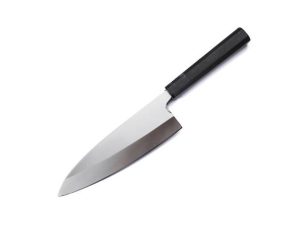
9Cr18Mov Clad Steel · Ebony Wa Handle · 185 mm
A single-bevel knife used for filleting and deboning fish while preserving delicate flesh.
Yanagiba

9Cr18Mov Clad Steel · Ebony Wa Handle · 300 mm
The iconic sushi knife, shaped like a willow leaf, perfect for ultra-thin slices of fish.
Unagisaki
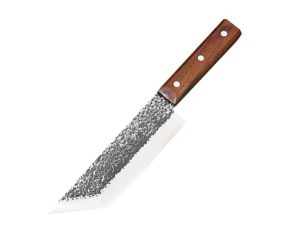
8Cr13MoV Rosewood · 175 mm
Designed specifically for eel filleting, featuring a thick, single-bevel blade.
Japanese Specialty Knives 103
Nakiri

8Cr13MoV Clad Steel · Rosewood Wa Handle · 165 mm
A vegetable knife with a flat profile and blunt tip, ideal for precise veggie prep.
Nakiri vs. Usuba
Usuba is preferred by professional chefs; Nakiri is more popular with home cooks.
Nakiri vs. Santoku
Santoku handles meat and veggies; Nakiri is strictly for produce.
Sujihiki
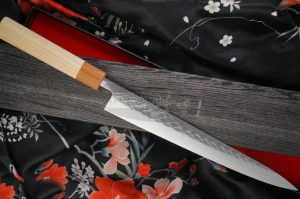
A long slicer for carving meats and fish in a single smooth motion.
Sujihiki vs. Yanagiba
Yanagiba for fish, Sujihiki for meat; Sujihiki’s double bevel suits Western users.
Petty Knives

Petty knives are another type of Japanese specialty tool and, contrary to their name, come with zero atittude. They can vary greatly in profile and size, ranging from 75mm to 210mm.
Design-wise, they resemble the Western utility or paring knives, featuring only minor differences that give them their unique Japanese flair.
They can be used for delicate tasks on the cutting board, yet they are mainly used in hand for piercing, peeling, and preparing small ingredients.
Honesuki
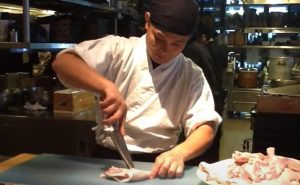
The Honesuki is another small Japanese knife that makes itself most helpful in breaking down and deboning soft meats like chicken. The name translates to “bone knife,” yet the Honesuki might be slightly different from what you’d expect from a Western-style deboning knife.
They have a thicker spine, with an angled cutting edge, tending on the flatter side. The blade ends in a sharp point and generally lacks the flexibility of a boning knife.
However, many users prefer it due to its excellent edge retention, and this lack of flexibility can become quite a blessing when cutting through tougher cartilage or bone.
Although the Honesuki is considered a specialized knife, one can very well use it instead of a petty knife when preparing veggies or fruit.
Pankiri
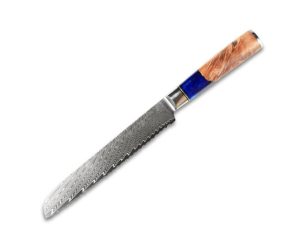
The Pankiri made its debut in Japan post-WWII when bread consumption increased. You guessed it; this makes the Pankiri the Japanese version of a bread knife.
It features a long, narrow, straight blade, typically between 240mm and 360mm.
This knife looks very similar to its Western counterpart, featuring a serrated edge and a skinny blade. Although mainly used for bread, it is also helpful for cutting cake or even braised meats.
Features of Japanese Kitchen Knives 201

Wa-Handle
Traditional Japanese knives usually come with a Wa-handle. These are lighter and offer a better forward balance than the typical Western (Yo) handles.
Since Japanese blades don’t have the thick, riveted tang we’re used to seeing on European blades, they can slide into their handle more easily. Likewise, this makes it easier to replace the handle if it becomes damaged, extending the knife’s lifespan quite a bit.
Generally, these handles have a tang around ¾ of the blade’s length and feature distinctive collars that contrast the exposed wood of the rest of the handle.
Single Bevel
Single or double bevels refer to the surface that has been ground to create a knife’s cutting edge. Looking closely at a blade, you’ll notice a slight angle on one or both sides that runs down to the edge. Those angles are the bevels.
Most traditional Japanese knives come with a single-beveled edge – the angle is formed on only one side. These knives are often referred to as chisel edge.
The main advantage of a single bevel is that it creates an extremely sharp knife, which is essential in Japanese cuisine for preparing delicate ingredients.
High-Hardness Steel
Japanese artisans always took special consideration when choosing their steel, with traditional Katanas being made of tamahagane steel. This material is only produced in the western part of Japan by smelting iron dust and pure coal.
The steel used for the production of knives is made using similar techniques.
Due to the high carbon content, traditional Japanese knives can be forged to a high hardness (60+ HRC) but remain very easy to sharpen and keep their edge for a long time.
Two of the most popular steel used are shiro-ko and ao-ko, which mean white steel and blue steel, respectively.
Should You Sell Japanese Knives in Your Store?
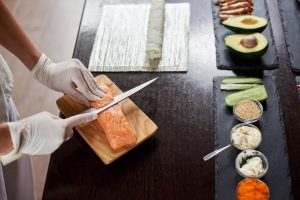
There’s no denying that Japanese knives are very popular choices worldwide. Apart from their elegant designs, these tools are known for their sophistication, durability, and excellent performance.
Few Western chefs in modern times don’t own at least one type of Japanese knife, and home cooks have also taken a liking to them for several reasons.
The Japanese multi-purpose knives are some of the most popular choices, out of which the Gyuto and Santoku knives practically sell themselves.
Should You Make a Japanese Knife Set?
Many buyers will look for ready-made sets that should include tools fit for the majority of tasks around the kitchen. Of course, creating the perfect set will depend on your general audience, but there are still some rules of thumb you can keep in mind.
To cover a broad range of use cases, a Japanese knife set should include a chef’s knife, such as a Gyuto or Santoku. If you’re going for a specialized set featuring the Kiritsuke as the main item, you can add the cleaver for some of the tougher cutting jobs.
Apart from these, you should include a vegetable knife, such as a Nakiri or Usuba, and a Yanagiba for fish (and aesthetics).
A petty knife or a Honesuki can cover the more delicate jobs and finish the set, but the Pankiri or Sujihiki can also represent valuable additions.
Recommended set composition:
-
Gyuto / Santoku – Chef’s knife
-
Nakiri / Usuba – Vegetable knife
-
Yanagiba – Fish knife
-
Petty / Honesuki – Delicate tasks
-
Pankiri / Sujihiki – Bread or carving knife
A glance over your competition will convince you how well Japanese knives sell. The well-known Japanese-style knives are often sold-out, and even the specialty knives quickly find their forever homes.

9 Types of Butcher Knives and Their Uses
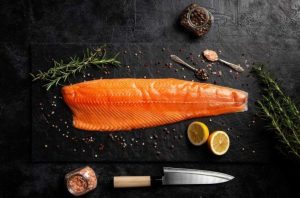
Japanese Deba: Fillet Knife with a Distinct Look