

Blog
Knife Knowledge Article

Ultimate Guide to Knife Types: Kitchen, Pocket, Japanese & More Explained
Knives come in all shapes and sizes and each one has a purpose. From kitchen prep to outdoor use, the right knife can make your work easier, faster, and safer.
In this guide, we’ll walk you through the main types of kitchen and pocket knives, what they’re used for, and how to choose the one that suits you best.
Whether you’re cooking at home or carrying a knife every day, this is a solid place to start.
Kitchen knives: Construction, essentials & styles
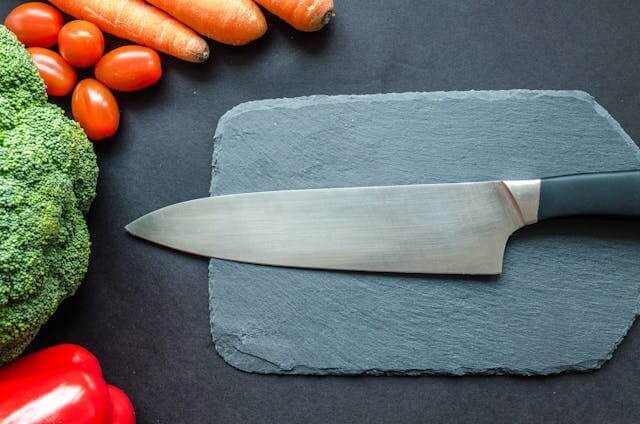
From dicing vegetables to deboning meat, kitchen knives are precision tools crafted for specific tasks.
And just like pocket knives, the variety can be overwhelming at first glance.
In this section, we’ll break down how kitchen knives are constructed, which ones are essential, and how different knife styles (Western vs. Japanese) impact performance.
Let’s begin with what lies beneath the blade: construction.
Kitchen knife construction
A good kitchen knife isn’t just about a sharp edge, how it’s built affects everything from performance to comfort. Let’s break down the key elements you should know before buying or using one.
Forged vs. stamped
- Forged knivesare made from a single piece of steel, shaped under high heat. They tend to be heavier, stronger, and include a bolster and full tang.
- Stamped knivesare cut from flat steel sheets and then heat-treated. They’re lighter, often more affordable, and easier to handle for beginners.
Neither is strictly better, forged knives feel solid and last longer, while stamped ones are more agile and wallet-friendly.
Tang & balance
The tang is the blade extension into the handle. Full tang = stronger and better balanced. Partial tang = lighter, cheaper, but sometimes less durable.
Balance is subjective: some cooks like a heavier blade-forward feel for chopping, others prefer a neutral or handle-heavy grip.
Steel types & hardness
- Stainless steelis common, rust-resistant and easy to maintain.
- High-carbon steelholds an edge longer but can rust without proper care.
- Hardnessis rated on the Rockwell scale (HRC). Japanese knives are often harder (60+), while Western knives are usually around 55–58 HRC. Harder = sharper, but more brittle. Softer = tougher, easier to sharpen.
Handles & ergonomics
- Handle Materialsinclude wood (traditional), plastic (durable), and composites like Micarta or G-10 (premium grip and durability).
- What matters most: it fits your hand, feels secure when wet, and suits your cooking habits.
Essential kitchen knives
If you’re building your kitchen knife lineup from scratch, you don’t need a giant 12-piece block. In fact, most chefs agree: three to five knives are all you really need for everyday cooking. Let’s break them down.
| Knife Type | Description | Common Uses |
| Chef’s Knife | A multi-purpose knife with a broad, curved blade and pointed tip. Typically 8-10 inches long. | Chopping, slicing, dicing, mincing vegetables, meats, and herbs. |
| Paring Knife | A small knife with a short, straight blade, usually 3-4 inches long. | Peeling, trimming, and delicate tasks like deveining shrimp or coring fruits. |
| Bread Knife | A long, serrated knife designed to cut through crusty exteriors without crushing the interior. | Slicing bread, cakes, and soft-skinned produce like tomatoes. |
| Utility Knife | A mid-sized knife, typically 5-6 inches, bridging the gap between a chef’s knife and a paring knife. | General-purpose slicing, such as cutting sandwiches or small fruits. |
| Carving/Slicing Knife | A long, narrow knife with a sharp point, designed for slicing cooked meats into thin pieces. | Carving roasts, turkey, ham, and other large cuts of meat. |
Chef’s knife (8–10″)
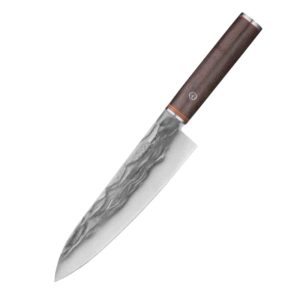
The ultimate all-rounder and the undisputed workhorse of the kitchen. A great Chef’s Knife feels like an extension of your hand. Its magic lies in the broad, gently curved blade, which allows for a smooth rocking motion—perfect for rapidly dicing onions, mincing herbs, or slicing through boneless meats. Its robust spine (around 2.5-3 mm) gives it enough heft to handle tougher jobs like splitting a squash.
Forged from reliable steels like X50CrMoV15 and hardened to a versatile 56-58 HRC, it strikes an ideal balance between holding an edge and being easy to maintain. This is the one knife that handles 80% of your kitchen tasks.
Best for: Chopping, slicing, dicing, mincing, nearly any prep task.
Paring knife (3–4″)
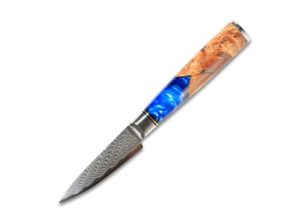
A paring knife is your go-to for detail work—peeling apples, trimming vegetables, or deveining shrimp. Its short, pointed blade (3–4 inches) offers fingertip control for delicate tasks that a chef’s knife can’t handle. Most paring knives use easy-to-sharpen stainless steel, since they’re often used for quick, light jobs. The slim, lightweight handle is designed for comfort during repetitive motions, making this knife a must-have for anyone who loves precision.
Some high-end paring knives use harder steels (like VG-10 or 9Cr18MoV) for longer edge retention, but for most home cooks, ease of sharpening and corrosion resistance are more important.
Best for: Peeling, coring, trimming, and detail work.
Bread knife (8–10″, Serrated)
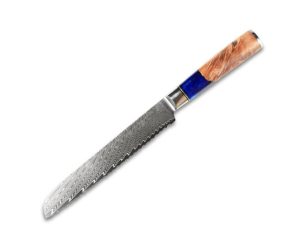
Not just for bread. A bread knife’s long, serrated blade (8–10 inches) is made to glide through crusty loaves without crushing the soft interior. The deep, scalloped teeth also make it perfect for slicing tomatoes, cakes, and other foods with a tough exterior and soft inside.
Most bread knives use corrosion-resistant stainless steel and feature an offset or raised handle to keep your knuckles clear. The blade is typically thinner than a chef’s knife, which helps it move smoothly through delicate pastries and soft produce. If you bake or love artisan bread, this knife is essential, and it’s also a secret weapon for slicing layered cakes or even pineapples.
Best for: Slicing bread, pastries, and soft-skinned produce.
Utility knife (5–6″)
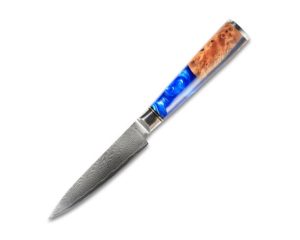
The in-between option. When a chef’s knife feels too big and a paring knife too small, a utility knife bridges the gap. Ideal for mid-sized tasks like slicing sandwiches or chopping small fruits.
Utility knives often use mid-range stainless steels for easy maintenance and a sharp edge. The comfortable, balanced handle makes it a reliable everyday tool for quick jobs. Some utility knives have a slight curve to the blade, making them more versatile for both push and pull cuts. They’re a great choice for prepping lunchboxes, slicing cured meats, or halving bagels.
Best for: Everyday, general-purpose slicing and light prep.
Carving Knife (8–12″)
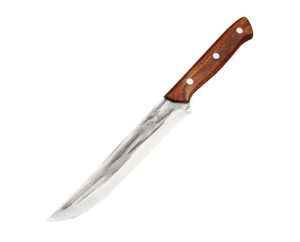
A carving knife features a long, narrow blade (8–12 inches) designed to glide through roasts, turkey, or ham in thin, even slices. The blade’s slim profile and slight flexibility reduce friction and help prevent tearing, while Granton (hollow) edges can keep meat from sticking. High-carbon stainless steel is common for a sharp, resilient edge. The handle is often elongated for a two-handed grip, giving you more control over large cuts. If you often serve roasts or large cuts, this knife brings restaurant-style presentation to your table and makes holiday carving much easier.
Butchery knives
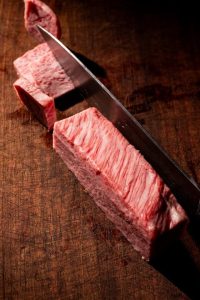
For those who regularly work with raw meats, poultry, or fish, butchery knives are essential. These specialized tools make breaking down proteins safer and more efficient.
| Knife Type | Description | Common Uses |
| Cleaver | A heavy, rectangular knife with a thick blade. | Chopping bones, sectioning meat, smashing garlic. |
| Boning Knife | A narrow, flexible knife with a sharp point. | Removing bones, trimming fat from meat or fish. |
| Fillet Knife | An ultra-thin, flexible knife for delicate work. | Filleting fish, removing skin, slicing thin cuts. |
| Cimeter | A large, curved knife for breaking down meat. | Trimming brisket, portioning steaks, slicing roasts. |
| Skinning Knife | A short, wide knife with a curved blade. | Skinning game or livestock. |
| Butcher Knife | A heavy, wide-bladed knife with a slight curve. | Breaking down large cuts, trimming raw meat. |
Cleaver
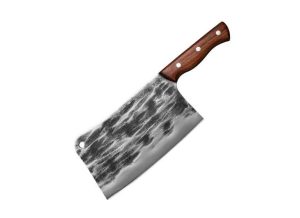
A Western meat cleaver is thick, heavy, and built for brute force—perfect for splitting bones or sectioning large cuts. Its broad, rectangular blade (6–8 inches) uses tough, impact-resistant steel like 420HC or 1095, prioritizing durability over razor-sharpness. The weight does the work, making it easy to chop through joints or crush garlic.
In contrast, a Chinese vegetable cleaver (also called a vegetable cleaver or “caidao”) is thinner and more versatile, often used for slicing and dicing as well. The handle is usually full-tang and robust, designed to absorb shock and provide a secure grip even when your hands are wet or greasy.
Best for: Chopping through bones, cutting tough meat, or smashing garlic.
Boning knife

A boning knife’s narrow, slightly curved blade (5–6 inches) is designed to maneuver around bones and joints. The blade’s flexibility is key for working close to the bone, trimming fat, or removing silver skin. Stiffer versions are great for pork and beef, while flexible ones excel with poultry and fish.
Most use high-carbon stainless steel for a sharp, easy-to-clean edge. The contoured handle ensures a secure grip, even when wet. A good boning knife can make the difference between wasting meat and getting the most out of every cut, especially for home butchery or breaking down whole chickens.
Best for: Separating meat from bone, trimming fat, working through joints.
Fillet knife
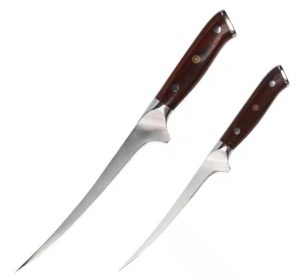
Often mistaken for a boning knife, the Fillet Knife takes flexibility to an extreme. It’s even thinner and more pliable, designed to bend and glide effortlessly between skin and delicate flesh.
To achieve this, it uses highly corrosion-resistant steels (like 420HC) and a slightly softer temper (56-58 HRC) that prioritizes toughness and flex over rigid hardness. This makes it the ultimate tool for creating perfect, translucent slices of fish without tearing the meat.
Best for: Filleting fish, removing skin, or slicing very thin cuts.
Cimeter
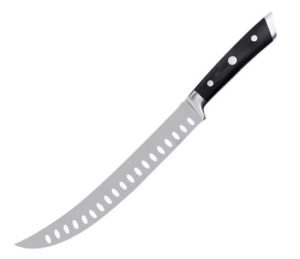
A cimeter (or scimitar) knife features a large, curved blade (10–12 inches) that excels at breaking down primal cuts, trimming brisket, or portioning steaks. The pronounced curve allows for long, smooth slicing motions, reducing drag and keeping cuts clean.
Durable stainless steel and a reinforced handle make it a favorite for heavy-duty butchery. The blade’s length and shape are ideal for trimming fat and silver skin from large cuts, and for portioning steaks with a single, clean stroke.
Best for: Breaking down primal cuts, portioning meat, trimming fat.
Skinning knife (Optional/Niche)
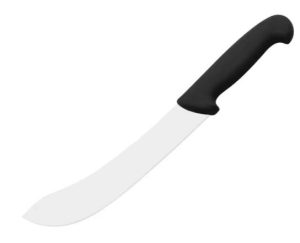
A specialized tool primarily for hunters. The Skinning Knife’s defining feature is its short, wide, and dramatically curved blade with a blunt tip. This unique shape allows the user to use the broad belly of the knife to peel back hide from an animal without accidentally piercing the muscle underneath. The focus is on controlled, upward-pulling cuts, making a sharp edge and a secure, non-slip grip paramount.
Best for: Skinning animals or breaking down game (less common in kitchens, but worth mentioning for completeness).
Butcher Knife
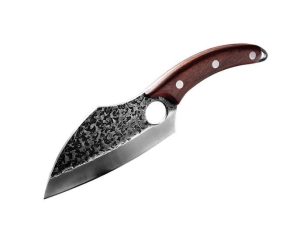
A heavy-duty, all-purpose butchery knife. While the Cimeter excels at long slices, the Butcher Knife is a more robust, versatile tool for portioning, trimming, and breaking down cuts. Its wide, slightly curved blade has enough heft to cut through thick sinew and cartilage, yet it’s nimble enough to trim fat. It’s the classic, multi-purpose workhorse found in every butcher shop, bridging the gap between a cleaver and a cimeter.
Best for: Breaking down large primal cuts, trimming fat and sinew, and portioning large pieces of meat.
Pro Tip: While you can get by with a chef’s knife and a boning knife, adding one or two butchery knives will drastically improve efficiency if you frequently handle meat or fish.
Specialty Knives
These knives are designed for specific tasks or ingredients, offering precision for niche cooking styles. While not essential for every kitchen, they can elevate your prep game for particular dishes or ingredients.
| Knife Type | Description | Common Uses |
| Tomato Knife | A small, serrated knife designed to handle delicate, soft-skinned produce. | Slicing tomatoes, soft fruits. |
| Cheese Knife | A knife with holes or a forked tip to prevent sticking when cutting cheeses. | Slicing soft or hard cheeses cleanly. |
| Steak Knife | A serrated or straight-edged dining knife for cutting cooked meats. | Cutting cooked meats at the table. |
| Butter Knife | A blunt, rounded knife designed for spreading soft ingredients. | Spreading butter, jams, or soft cheeses. |
| Oyster Knife | A short, thick knife for safely prying open oyster shells. | Shucking oysters. |
| Mincing Knife | A curved knife with handles for rocking cuts, ideal for mincing. | Mincing herbs, garlic, and vegetables. |
| Garnishing Knife | A small knife for creating intricate, decorative cuts. | Creating garnishes or carving produce. |
| Tourné Knife | A short, curved knife for peeling, shaping, and turning vegetables. | Peeling, turning, and precision vegetable work. |
| Salmon Knife | A long, thin knife for slicing delicate fillets, especially smoked salmon. | Slicing smoked salmon or soft proteins. |
Tomato Knife

A tomato knife’s small, serrated blade (5–6 inches) is perfect for slicing through delicate, soft-skinned produce without crushing it. The offset handle keeps your knuckles clear, and the fine teeth make clean cuts through tomatoes, kiwis, or even soft cheeses. Some tomato knives feature a forked tip for lifting slices, and the blade is usually made from stainless steel for easy maintenance.
Best for: Slicing tomatoes and other soft fruits.
Cheese Knife
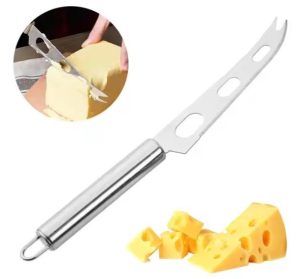
Cheese knives often feature holes in the blade or a forked tip to prevent sticking when cutting soft or semi-soft cheeses. The thin, sharp edge glides through brie, camembert, or even hard cheeses like cheddar, while the ergonomic handle ensures comfort. Some cheese knives use high-carbon stainless steel for extra sharpness, and the unique blade shapes are designed to handle everything from crumbly blue cheese to dense aged gouda.
Best for: Slicing soft, semi-soft, and hard cheeses.
Steak Knife
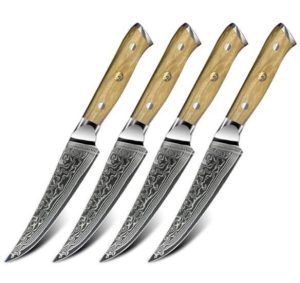
Steak knives are designed for diners, not chefs. Their sharp, often serrated blades (4–5 inches) make it easy to cut through cooked meats at the table, ensuring a clean, effortless bite. Handles are typically made from wood or durable polymers for a comfortable grip, and the blade is usually stainless steel for easy care.
Best for: Cutting cooked meats at the table.
Butter Knife
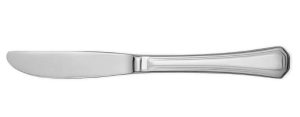
A butter knife has a wide, blunt blade designed for spreading soft ingredients like butter, jam, or soft cheese. The rounded tip protects delicate foods and makes spreading easy. Most butter knives are made from polished stainless steel for a smooth, non-stick finish.
Best for: Spreading butter, jams, or soft cheeses.
Oyster Knife

Oyster knives are short, thick, and sturdy, built to pry open oyster shells safely. The pointed tip and robust handle provide leverage and control, making shucking oysters safer and easier. The blade is typically made from tough stainless steel to resist corrosion from saltwater, and the handle is often textured for a secure grip.
Best for: Shucking oysters.
Mincing Knife
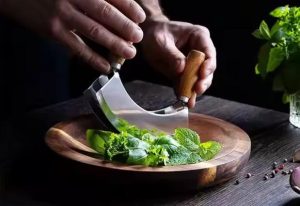
A mincing knife, or mezzaluna, features a curved blade and dual handles for a rocking motion that quickly minces herbs, garlic, or vegetables into fine pieces. It’s a favorite for anyone who preps large amounts of herbs or aromatics. The blade is usually stainless steel, and the handles are designed for comfort during repetitive rocking motions.
Best for: Mincing herbs, garlic, and vegetables.
Garnishing Knife
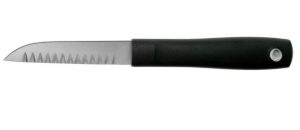
A garnishing knife is slim and flexible, designed for creating intricate, decorative cuts in fruits and vegetables. It’s the tool of choice for chefs who love presentation and detail. The blade is often made from high-carbon stainless steel for precision, and the handle is shaped for maximum control during delicate work.
Best for: Creating garnishes or carving produce.
Tourné Knife (bird’s beak paring knife)
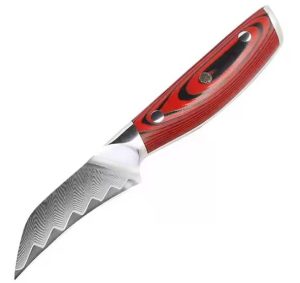
The tourné knife’s short, curved blade (2.5–3 inches) is perfect for peeling round produce and shaping vegetables into uniform, decorative pieces. Its unique shape gives you control for precision work. The blade is usually thin and sharp, and the handle is designed for a comfortable grip during intricate tasks.
Best for: Peeling, turning, and precision vegetable work.
Salmon Knife
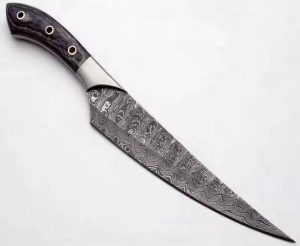
A salmon knife’s long, thin, and flexible blade (10–12 inches) is designed to slice smoked salmon or other soft proteins into thin, even pieces without tearing. The hollow edge reduces sticking, and the ergonomic handle ensures comfort during extended use. High-end salmon knives often use Japanese steels for extra sharpness and flexibility.
Best for: Slicing smoked salmon or delicate fillets.
Japanese Knives
Japanese knives are renowned for their precision, sharpness, and specialized designs, optimized for specific ingredients or techniques. These knives often feature thinner, harder blades than their Western counterparts, making them ideal for tasks that require finesse and accuracy.
| Knife Type | Description | Common Uses |
| Santoku | A versatile Japanese knife with a shorter, wider blade and granton edge to reduce sticking. | Chopping vegetables, slicing meat, mincing herbs. |
| Nakiri | A specialized vegetable knife with a straight, rectangular blade for clean, precise cuts. | Slicing and chopping vegetables for salads or garnishes. |
| Gyuto | A Japanese chef’s knife with a thinner, sharper blade, offering exceptional versatility. | All-purpose slicing of meat, fish, and vegetables. |
Santoku
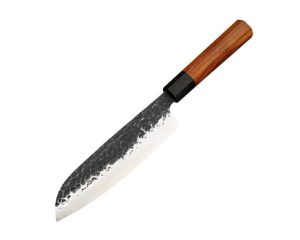
Santoku means “three virtues”—meat, fish, and vegetables. This compact, agile knife (5–7 inches) features a flat-edged, sheepsfoot-tipped blade with granton scallops to reduce sticking. Japanese santoku knives are often made from harder steels like VG-10 or AUS-10, giving them a sharper edge that lasts longer, though they require more careful handling. The handle is typically lighter and more blade-forward than Western knives, making it easy to control for precise cuts.
Santoku knives excel at chopping, slicing, and mincing, especially in smaller kitchens or for cooks who prefer a lighter, more nimble tool.
Best for: Chopping vegetables, slicing meat, mincing herbs.
Nakiri
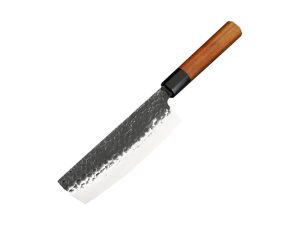
The nakiri is a straight-edged, rectangular knife (6–7 inches) designed for clean, precise vegetable cuts. Its thin blade and flat profile make it perfect for push-cutting and creating ultra-thin slices for salads or garnishes.
Nakiri knives are often made from high-carbon Japanese steels like Blue Steel or White Steel, which can reach higher hardness (60–62 HRC) for exceptional sharpness. The handle is usually traditional Japanese wa-style, offering a comfortable grip for repetitive chopping.
Gyuto
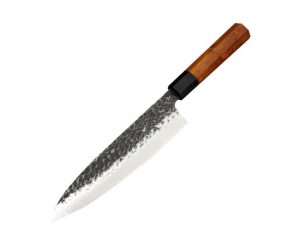
The gyuto is Japan’s answer to the Western chef’s knife, but with a thinner, sharper blade (8–10 inches) and a lighter, blade-forward balance. It’s versatile enough for meat, fish, and vegetables, and is prized for its precision and agility.
Many gyuto knives use advanced steels like SG2 or VG-10, which hold a keen edge but require careful maintenance. The handle is often octagonal or D-shaped for a secure, comfortable grip, making the gyuto a favorite among professional chefs and serious home cooks alike.
Best for: All-purpose slicing of meat, fish, and vegetables.
Japanese vs. Western Knives
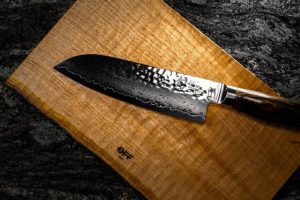
Western (European-style) and Japanese kitchen knives may look similar at a glance, but they differ greatly in materials, design philosophy, and how they’re used.
Choosing between them often comes down to cooking style and personal preference.
Let’s break down the key differences.
| Feature | Japanese Knives | Western Knives |
| Blade Steel | Harder, high-carbon steel (e.g., VG-10, White #1) | Softer stainless steel or high-carbon blends |
| Edge Angle | Sharper (often 12–16°) | Slightly wider (typically 20–22°) |
| Bevel Style | Often single bevel (one-sided) or double bevel | Usually double bevel |
| Blade Thickness | Thinner, more precise | Thicker, more robust |
| Weight & Balance | Lighter, blade-forward | Heavier, more handle-balanced |
| Sharpening Needs | Holds edge longer but can chip; needs whetstone | Easier to sharpen; more forgiving |
| Best For | Precision cuts, vegetables, sushi | Heavier tasks, all-around Western cooking |
Which should you choose?
- If you value ultra-sharp precision and mainly prep veggies, fish, or boneless meats: go Japanese.
- If you want forgiving, all-purpose tools that can handle rougher use and a wider range of tasks: go Western.
- Or mix both, many modern kitchens use a blend of styles to get the best of both worlds.
Pocket knives: Types, features & use cases
Pocket knives aren’t just tools, they’re personal companions for everyday life, outdoor adventures, and even emergencies.
Whether you’re opening packages at work or slicing kindling on a hike, the right knife can make a big difference.
In this section, we’ll walk you through the different types of pocket knives, their core features, and the most common ways people use them.
Fixed Blade vs. Folding Knives
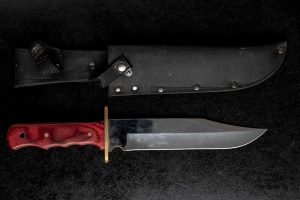
The first decision when choosing a pocket knife? Deciding whether you want a folding knife or a fixed blade.
| Feature | Folding knife | Fixed blade |
| Blade Design | Blade folds into the handle | One solid piece of steel |
| Portability | Compact and pocket-friendly | Requires a sheath for safe carry |
| Strength | Slightly weaker due to hinge and lock | Extremely strong and durable |
| Ease of Use | Convenient for EDC and urban tasks | Reliable in outdoor or heavy-duty tasks |
| Maintenance | Needs regular cleaning around pivot & lock | Easier to clean; fewer moving parts |
| Legal Limitations | Generally more accepted in urban carry laws | Often restricted or requires open carry |
When to choose what:
- Folding knivesare great for urban use, work, and everyday carry (EDC). They’re discreet, compact, and legal in most places.
- Fixed bladesshine in outdoor, survival, or tactical settings where strength and speed matter such as camping, hunting, or rescue operations.
Common blade shapes and their applications
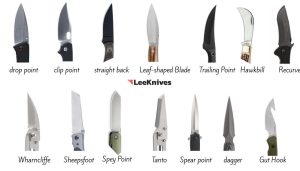
Blade shape directly impacts how a knife performs. Here are the most popular shapes and when to use them:
1. The all-rounders
These are the workhorses of the knife world. If you can only have one knife, it’s likely to be one of these highly adaptable shapes.
Drop Point
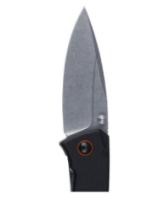
The Drop Point is arguably the most popular and versatile blade shape. Its defining feature is a spine that gently and continuously curves down to meet the tip, creating a strong, easily controllable point and a large cutting edge, or “belly,” for excellent slicing.
- Pros:Very strong and controllable tip, large belly for easy slicing, extremely versatile.
- Cons:The tip is less sharp and narrow than a Clip Point, making it slightly less ideal for delicate piercing.
- Best For:Everyday Carry (EDC), hunting, camping, general utility. This is the best choice for a beginner.
Clip Point/Bowie
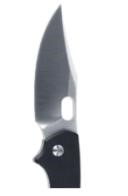
A classic American design, the Clip Point/Bowie is another highly versatile shape with an emphasis on piercing. The spine runs straight before being “clipped” off near the end, either in a straight line or a concave curve. This creates a much thinner, sharper, and more aggressive point. The iconic Bowie knife is the most famous example.
- Pros:Superior piercing capability, excellent for detail work, still has a good belly for slicing.
- Cons:The fine tip is inherently weaker and more prone to chipping or breaking than a Drop Point.
- Best For:Tactical knives, hunting, self-defense, general-purpose knives where piercing is a priority.
Straight Back
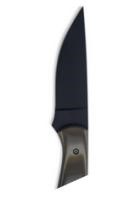
Also known as a “Normal” blade, this is one of the most traditional and straightforward designs. It features a completely straight spine and a curved edge that sweeps up to meet it. This simple geometry concentrates force for chopping and provides a long, straight belly for predictable slicing.
- Pros:Strong and heavy-duty, excellent for chopping and slicing, easy to control.
- Cons:The tip is not designed for piercing and can feel less nimble than other shapes.
- Best For:Kitchen cutlery (Chef’s Knives), heavy-duty utility knives, survival knives.
Leaf-shaped Blade
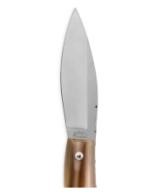
Popularized by modern knife makers, the Leaf-Shaped blade is a highly functional evolution of the Spear Point. It’s wide from spine to edge but tapers symmetrically to a very sharp point, resembling a leaf. This design provides a very strong tip combined with a generous belly.
- Pros:Exceptionally strong tip, great slicing and piercing ability, very ergonomic for many tasks.
- Cons:The width of the blade can sometimes be cumbersome in tight spaces.
- Best For:EDC, tactical use, and utility tasks that require both strength and slicing performance.
1. The all-rounders
These are the workhorses of the knife world. If you can only have one knife, it’s likely to be one of these highly adaptable shapes.
Wharncliffe
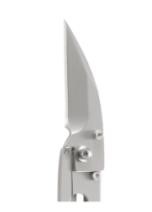
The ultimate utility slicer, the Wharncliffe is designed for pure cutting power and control. It has a perfectly straight cutting edge and a spine that slopes down dramatically to meet it at a very fine, acute point.
- Pros:Maximum control for scoring and carving, incredible power at the tip for starting cuts.
- Cons:The lack of a belly makes it awkward for roll cuts; the fine tip can be delicate.
- Best For:Opening boxes, crafts, electrical work, whittling, and any task requiring a long, clean slice.
Sheepsfoot
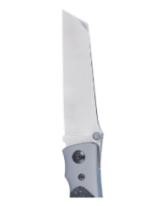
The safer cousin of the Wharncliffe, built for slicing without the risk of accidental piercing. Sheepfoot has the same straight cutting edge, but the spine curves down steeply to meet the edge, creating a completely blunt, rounded tip.
- Pros:Extremely safe due to the lack of a point, excellent slicing power.
- Cons:Has virtually no piercing capability.
- Best For:Emergency rescue (cutting seatbelts), boating/rigging, and for anyone needing a safe utility blade.
Spey Point
Originally designed for spaying livestock without injuring the animal, the Spey point is another safety-focused blade. It has a mostly straight edge that curves up sharply to a broad, obtuse tip with almost no point. The spine is also clipped flat near the end to make the tip even less pronounced.
- Pros:Very safe and resistant to accidental piercing, offers a long, straight edge for clean cuts.
- Cons:Poor piercing ability, highly specialized shape.
- Best For:Traditional pocket knives (like the Stockman pattern), skinning small areas, tasks requiring careful slicing near sensitive surfaces.
3. The Powerhouses & Piercers
When you need to puncture tough materials or demand maximum tip strength, these shapes deliver.
Tanto
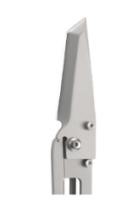
Inspired by Japanese swords, the Tanto is built for formidable strength. Instead of a continuous curve, the Tanto has two distinct straight edges that meet at an angular point. This geometry creates a massive amount of metal supporting the tip, making it exceptionally strong.
- Pros:The strongest tip of any blade shape, powerful piercing through hard materials.
- Cons:Poor for general slicing due to the lack of belly, can be more difficult to sharpen.
- Best For:Tactical and military applications, self-defense, piercing tough materials like sheet metal or body armor.
Spear Point
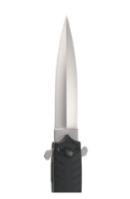
A symmetrical blade designed for a straight line of force. Both the spine and the cutting edge curve equally to meet at a tip that is perfectly aligned with the blade’s centerline. They can be single-edged or, more commonly, double-edged.
- Pros:Excellent for thrusting due to its balance and alignment, strong tip.
- Cons:The small belly on single-edged versions makes them less effective for general slicing.
- Best For:Throwing knives, daggers, combat-style blades.
Dagger
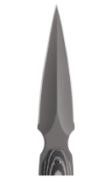
The ultimate piercing tool, a Dagger is a double-edged Spear Point. Symmetrical and often slender, it is sharpened on both sides to a needle-like point, offering no resistance upon entry and exit.
- Pros:Unmatched piercing and thrusting capability.
- Cons:Very specialized; often illegal to carry. Lacks utility for slicing or everyday tasks. The tip is fragile.
- Best For:Combat, self-defense, and collection pieces.
4. Trailing Point
These blades use unique curves to maximize their cutting edge for specialized tasks.
Trailing Point
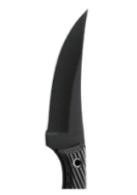
With its dramatic upswept design, this blade offers the longest possible cutting edge. The spine curves upward, raising the tip significantly higher than the handle. This creates a large, sweeping belly that is perfect for long, slicing cuts.
- Pros:Master slicer with a huge belly, nimble tip for detail work.
- Cons:The high, thin tip is delicate and not suitable for piercing. The point can be difficult to control.
- Best For:Filleting fish, skinning game, food preparation.
Hawkbill/ Karambit
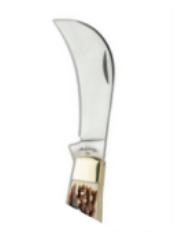
A blade that cuts in the opposite way of most knives. The blade curves inward like a claw or a talon, with the cutting edge on the inside of the curve. This shape naturally hooks and pulls material into the sharpened edge.
- Pros:Incredible for pull cuts, extremely secure once it hooks into material.
- Cons:Very specialized; difficult to sharpen and almost useless for piercing or straight-line slicing.
- Best For:Cutting cordage, rope, carpet, and linoleum; pruning; in the Karambit form, for martial arts.
Recurve
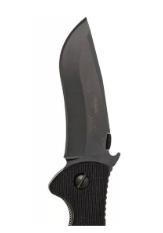
A Recurve isn’t a shape itself but a blade with an “S” shaped curve to its edge. This inward curve near the handle pulls material into the main belly of the blade as you cut, making it an exceptionally aggressive slicer. It is often combined with other shapes like the Drop Point.
- Pros:Superior and aggressive slicing ability, excels at cutting fibrous materials.
- Cons:Can be significantly more difficult to sharpen correctly without specialized tools.
- Best For:Fighting knives, aggressive utility knives, and tasks requiring powerful slicing.
5. Specialized Features
Gut Hook
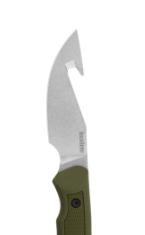
Commonly found on hunting knives, the Gut Hook is not a blade shape but a small, sharpened hook integrated into the spine of another blade shape (like a Drop Point).
- Pros:Allows you to open the abdomen of game quickly and safely without piercing the entrails.
- Cons:Weakens the spine of the blade; can snag on brush or clothing; requires a separate tool to sharpen.
- Best For:Field dressing large game.
Commonly found on hunting knives, the Gut Hook is not a blade shape but a small, sharpened hook integrated into the spine of another blade shape (like a Drop Point).
- Pros:Allows you to open the abdomen of game quickly and safely without piercing the entrails.
- Cons:Weakens the spine of the blade; can snag on brush or clothing; requires a separate tool to sharpen.
- Best For:Field dressing large game.
Opening mechanisms
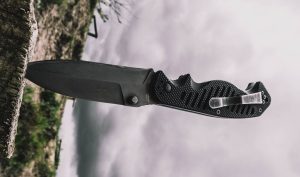
How a knife opens affects speed, legality, and ease of use. Here are different types of opening mechanisms:
1. Manual Opening
These knives rely entirely on the user’s physical input to open the blade. They are the most common and widely legal type.
Nail Nick / Groove: This is the most traditional method, featuring a small cutout in the side of the blade that you catch with a fingernail to pull it open.

- Pros:Classic aesthetic, mechanically simple, no parts to snag on clothing.
- Cons:Almost always requires two hands and is the slowest method of deployment.
- Found On:Swiss Army Knives, traditional slipjoint folders (e.g., Case knives).
Thumb Stud / Disk: A small stud or disk is mounted on the blade, providing a purchase point for your thumb to sweep the blade open in an arc.
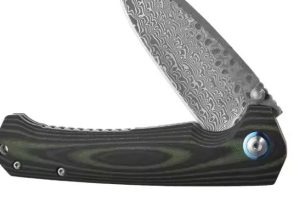
- Pros:Allows for easy and reliable one-handed opening.
- Cons:Can sometimes snag on pocket fabric during retrieval.
- Found On:The vast majority of modern folding knives (e.g., many Benchmade and Kershaw models).
Thumb Hole: Popularized by Spyderco, this method replaces a stud with a hole cut directly into the blade. The user presses their thumb against the edge of the hole to swing the blade open.
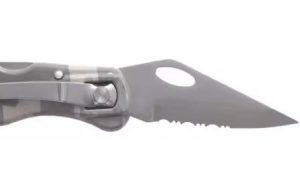
- Pros:Fully ambidextrous, won’t snag, easy to use even with gloves on.
- Cons:Can have a slight learning curve compared to a thumb stud.
- Found On:Primarily Spyderco knives and many designs inspired by them.
Flipper Tab: A small protrusion on the spine of the blade’s tang is exposed when the knife is closed. The user presses down on this tab with their index finger, using it as a lever to rapidly “flip” the blade open.

- Pros:Extremely fast and intuitive, satisfying to use, and the tab doubles as a finger guard when open.
- Cons:The tab adds to the length/profile of the knife when closed.
- Found On:A huge number of modern EDC and tactical knives.
2. Assisted Opening
An assisted opener is a hybrid system. You begin opening the blade manually (using a thumb stud or flipper), and once the blade is pushed past a certain point, an internal spring takes over and snaps it open the rest of the way with authority.
- Pros:Offers rapid, reliable, and positive deployment without being a fully automatic knife.
- Cons:Legality can be a gray area in some restrictive regions; the spring adds mechanical complexity.
- Best For:Users who want fast one-handed opening but cannot or do not want to carry an automatic knife.
3. Automatic (Switchblade)
An automatic knife deploys its blade instantly with the press of a button or the slide of a switch. The blade is held under spring tension at all times and is released by the activation of the mechanism.
- Pros:The fastest possible blade deployment, ideal for emergency or tactical situations where seconds count.
- Cons:Heavily regulated and illegal to own or carry in many countries, states, and cities.
- Best For:Military, law enforcement, and emergency first responders (where legally permitted).
4. Gravity / Inertia Opening
These knives open without springs, relying instead on manual manipulation and inertia.
Balisong (Butterfly Knife): This design features a blade concealed within two handles that rotate independently. The user manipulates the handles in a specific sequence, using momentum to flip the knife open or closed.
- Pros:Very strong lockup when open, can be deployed very quickly with practice.
- Cons:Often illegal for carry due to cultural stigma and requires significant skill to operate safely and effectively.
Gravity Knife: A blade that slides or pivots out of the handle purely by the force of gravity, typically after a button or lever is pressed to release it from its locked position.
- Pros:Simple, reliable mechanism with few moving parts.
- Cons:Very rare today and also heavily regulated in most places.